Who planted the first tree?
Almost every history of Philippine coffee opens the same way. In 1740 a Spanish Franciscan friar carries three gantas of coffee seed from Mexico on the Manila galleon and plants them in Lipa, Batangas. It is a lovely story, and it is very hard to find in the record.
The trail has been followed back. The 1740 date was popularised by Rafael Bartolome, a Department of Agriculture horticulturist, in articles from 1950 onward. Bartolome's source was an article in The American Chamber of Commerce Journal of Manila in 1928, headlined "Franciscan Friar Brings Coffee to the Philippines: Three Gantas of Arabian Seed from Mexico 188 Years Ago". That article in turn rested on a memorandum by Quirino B. Aguilera of the Lipa experiment station, who gave no source.1 The date itself is a little older than the article. William Ukers's standard reference All About Coffee (1922) already says that "in 1740 Spanish missionaries introduced coffee cultivation into the Philippines", but from Java, not Mexico; two hundred pages later the same book says late eighteenth century, from Mexico.16 No eighteenth-century document confirming it has been found. Coffee does not appear in William Schurz's exhaustive study of the galleon cargoes, and coffee was planted in Mexico only around the 1790s, half a century after the friar supposedly brought it from there.1
The earliest official account says something quite different. In 1903 the Governor of Batangas, Simeon Luz, wrote the coffee chapter of the first American census. He began with what the archives did not hold.
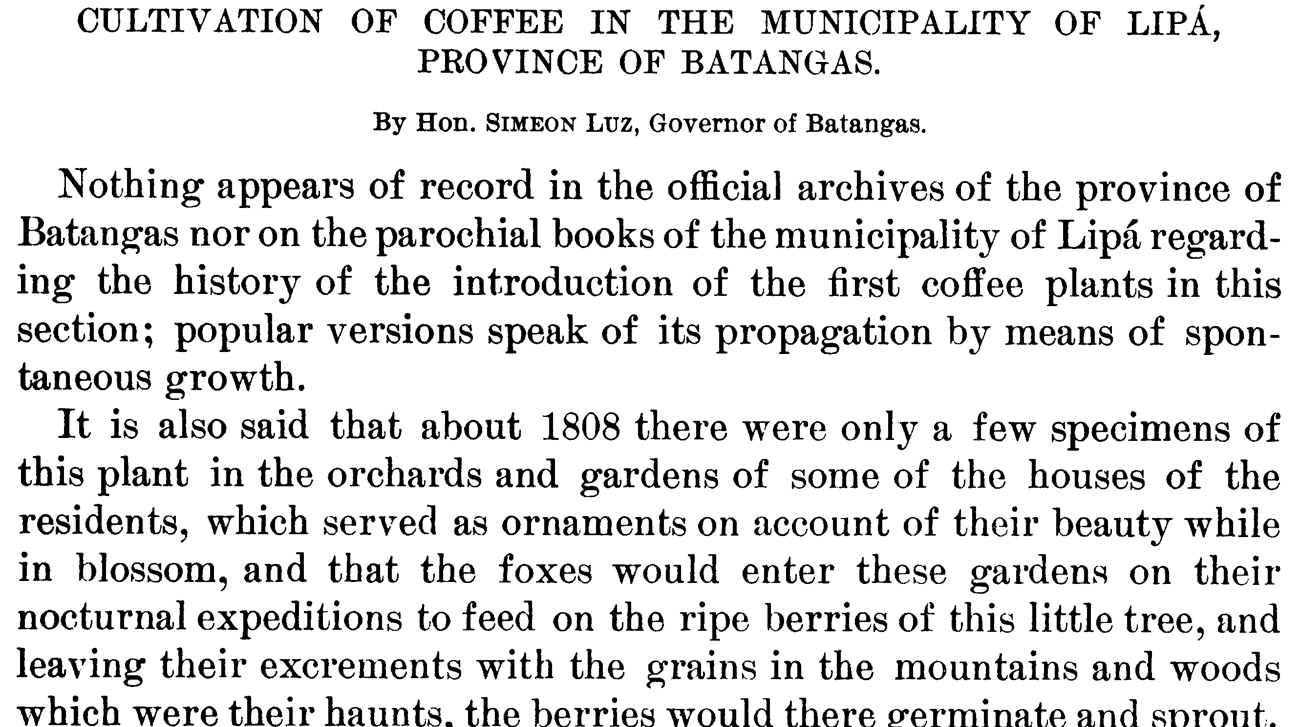
The census itself is cautious: coffee "is said to have been brought to the islands by Spanish missionaries during the latter part of the eighteenth century", its systematic cultivation began early in the nineteenth, and it "was first cultivated in the province of La Laguna", not Batangas.2 The oldest local date in print comes from Manuel Sastrón, a Spanish official who wrote up the province in 1895: "it is known that the first coffee trees were sown in what is now the Villa de Lipa around the year 1814", when the Augustinian Fr. Elías Lebredo was parish priest and Galo de los Reyes was gobernadorcillo.17 Valentín Marín (1901) also gives 1814, and a Lipa local historian suggests 1784.3 Some modern accounts spell the friar's name Nebreda; Sastrón's printed text reads Lebredo.
What the travellers saw fits a late arrival. In 1810 Tomás de Comyn found people drinking cacao, not coffee, though he rated the little coffee grown at Indang and Silang in Cavite "on a parallel with the coffee of Bourbon".18 In 1819 the Englishman Henry Piddington wrote that coffee had been almost unknown forty years before, with a few plants in Manila's botanical garden that were carried to Laguna.3 The American naval officer Charles Wilkes, in Manila in 1842, was told coffee had been "introduced into the gardens of Manila, about fifty years ago", and spread across the island by civets.18 The honest answer is that nobody knows who planted the first Philippine coffee tree, or when. It was probably in the second half of the eighteenth century, and probably not in 1740.
Ordered to plant
Coffee did not spread through Batangas on its own. Luz records that around 1808 Lipa had only a few ornamental trees, and that the town's gobernadorcillo, Don Galo de los Reyes, used his authority to make residents plant it. He kept at it through his re-elections in 1812, 1822 and 1825, and his son Santiago carried on after 1832.2 A contemporary Spanish account is blunter: the gobernadorcillo of Lipa compelled people to plant coffee, and anyone who refused was beaten and walked through town with a sign on his back.3
Manila pushed too. The Real Sociedad Económica de Amigos del País offered cash prizes for the first plantations of 60,000 trees and printed growing manuals, one of them translated into Tagalog. The Frenchman Paul de la Gironière collected the first prize for his estate at Jalajala on Laguna de Bay.3 The German traveller Fedor Jagor dates it to 1837 and puts it at $1,000, but the other early accounts disagree on the sum, the size of the plantation and who earned it.1819 Still, growth was slow. Piddington recorded the islands' first coffee export in 1818, some 400 picos gathered from wild trees.1 As late as 1850 most Batangas farms counted only about two hundred trees.3
The Batangas boom
According to Luz, coffee planting "on a large scale did not begin in Lipa and in the adjoining municipalities until the year 1859". Thirty years later about two-thirds of the district of Lipa was under coffee.2 The price did the rest: a picul that had fetched 3 to 10 pesos in Manila reached 20 to 25 pesos in the years just before 1889.2 Sastrón gives the figures for 1887: Lipa alone sent out 70,000 picos of coffee and the neighbouring towns another 15,000, sold at about 30 pesos a pico, some two and a half million pesos in all.17 Batangas coffee, sold abroad as "Manila", was graded above the coffee of the other Luzon provinces and well above Mindanao's.2
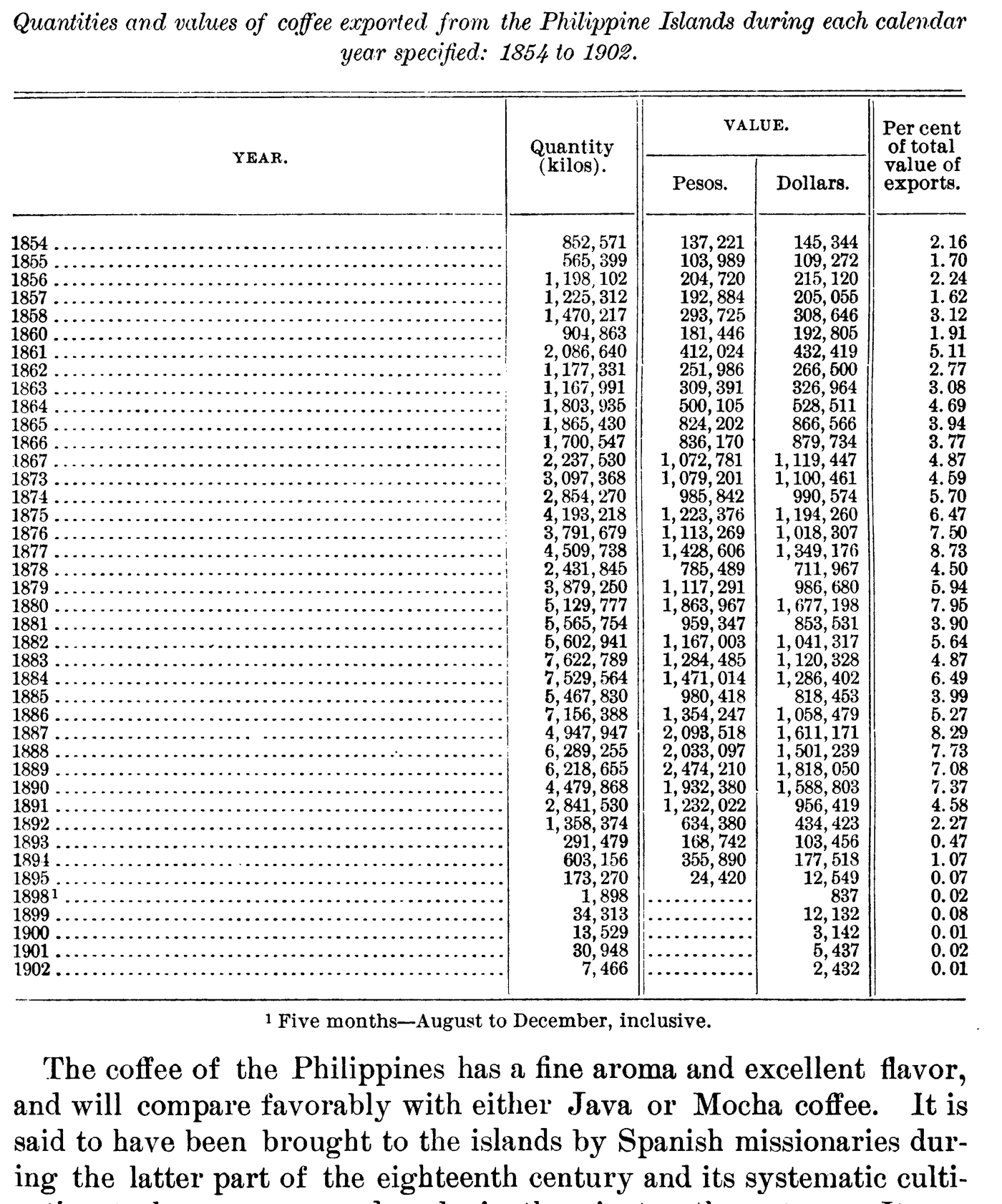
Philippine coffee exports, 1854 to 1902
Kilograms exported each year. Gaps are years with no surviving statistics.
Source: Census of the Philippine Islands, 1903, vol. IV, p. 77. 1898 covers August to December only.
Show the table
The official series tells the story in one line. Exports passed a million kilos in 1856, reached 5.1 million in 1880 and peaked at 7.62 million kilos in 1883. By value the best year came later, in 1889, at 2.47 million pesos, because prices kept climbing after volumes had begun to slip.2 Through the 1880s coffee ranked third or fourth among the islands' exports by value, behind abaca and sugar, and in 1887 it was worth 8.3 per cent of everything the Philippines sold abroad.23
The money changed Lipa. Lipa growers showed coffee at the Philadelphia Centennial Exposition of 1876 and at the Madrid Exposition of 1887, and in 1887 the Queen Regent María Cristina raised Lipa to the rank of villa.3 Planter families grew rich and intermarried; one Lipa house of the time is described with a piano from Spain, Venetian mirrors and Louis XV furniture. The wealth did not reach everyone. Sharecroppers worked for half the harvest, and small farmers sold next year's crop in advance at half price, a practice called pasong that kept many in permanent debt.3 Buyers drove the same system from the other end. Writing in 1899, the Filipino author Ramón Reyes Lala described coffee as "a good deal of a speculation in the islands": collectors toured the country paying for crops still on the tree, advancing perhaps eight dollars a picul where the last harvest had fetched twelve, and "in one case, some years ago, coffee advanced to $31 a picul, and enormous fortunes were made".20
Worms, then rust
Lipa held its fiesta in 1888 with a float carrying a coffee plant. The next year the trees began to die.3 Luz's account of what happened is the closest thing we have to a planter's own record:
"Two kinds of worms caused the total destruction of the coffee plantations of Lipa and of the other townships of the province… in 1889, to the great surprise and fear of all, it was observed that all the plantations of the province were attacked. That year saw the total loss of the crop and the death of almost all the coffee plants."
Simeon Luz, Governor of Batangas, 19032
The insects, which Luz calls hunus and bagumbung, had always been present and had never done much harm. The Spanish government sent the engineer Domingo Sánchez to study them, and his report was printed in Manila in 1890.3 Two years after the worms, the surviving trees put out new branches, and then yellow-red spots appeared on the leaves. A census editor's footnote identifies it as Hemileia vastatrix, coffee leaf rust.2 Old, crowded, overworked trees suffered most: Luz noted that only half of Lipa's plantations were still bearing.2
Outsiders watched it happen in the trade returns. A United States Department of Agriculture bulletin of 1898, compiled from the Manila customs figures, shows exports of 15.0 million pounds (about 6,800 tonnes) in 1888, then 13.1, 10.7, 6.4 and 3.0 million pounds a year, and just 200,480 pounds (about 90 tonnes) in 1896. It put the decline down to "the ravages of an insect".21 Sastrón, writing in 1895, dates it the same way: the decline began in 1888, worsened in 1889 and 1890, and by 1891 and 1892 the trees were nearly gone.17 The sources disagree on the cause in their emphasis. Spanish and American writers of the 1890s blame the boring insect; later agricultural writers, Wester among them, speak of blight. Both were probably at work.
Rust alone does not explain it. Castro argues that worn-out soils, the loss of forest, monoculture and a lack of investment mattered as much as the fungus.1 Then came the Revolution of 1896, the war with the United States, and rinderpest, which killed most of the province's carabaos and cattle by 1902.3 Planters cleared their land for sugar cane, rice and corn. By the 1902 farm count the whole country had just 999 hectares of coffee, a third of it in Cavite, and the Philippines had begun importing coffee.23 A 1903 report on a proposed railway through Batangas recorded that coffee worth two to three million (in silver) had once left Lipa each year, and that "planters are now talking of replanting".4
Barako and the highlands
The coffee that made Lipa rich was Arabica. The coffee Batangas is famous for today, kapeng barako, is a different species, Coffea liberica, and it arrived as a response to the collapse. A 1925 article in the Philippine Agricultural Review credits Manuel Genato with bringing Liberica from Manila to a three-hectare farm in San Jose, Batangas, in 1891, and distributing its seed to Lipa, Rosario, San Pablo and Tiaong.3 Luz saw that farm, or one like it: in 1903 he mentions "a plantation of Liberia coffee of considerable extent" in San José owned by a rich Manila resident, noting that it yielded less than "the primitive coffee".2 In 1902 Batangas had only 145 hectares of coffee of any kind. Barako took decades to become the province's signature.3
Arabica, meanwhile, moved uphill. The same census carries a report by the American governor of Benguet, W. F. Pack, which says coffee was introduced there in 1875 by the Spanish military governor and moved in 1877 to plateaus at 4,000 to 5,000 feet, where no rust had appeared. When a later governor ordered everyone to plant coffee in 1881, the people of Daklan, on the advice of their elders, pulled up the seedlings and finally poured boiling water on them. In Kabayan it took hold, and by 1902 Benguet produced 852 cavanes.2 It is an early sign of something that runs through this whole history: coffee did best where growers chose it, and worst where it was imposed.
The twentieth century
Under American rule the Bureau of Agriculture tested new coffees in Lipa as early as 1903; Luz wrote that "everyone is convinced that coffee is the only product that can save the critical situation" of the town.2 Coffee came back slowly, and when it did, it came back as a different crop in a different place: mostly Robusta, mostly in Mindanao, mostly bound for instant coffee.
A new species for a ruined trade
By 1913 the islands grew only 113,031 kilograms of coffee and imported ten times as much, 1,138,781 kilograms. The figures come from P. J. Wester, the horticulturist in charge of the Bureau of Agriculture's Lamao Experiment Station in Bataan, whose 1915 report "Coffee in the Philippines" set the course for the next half-century. Arabica, he concluded, "cannot be profitably grown here below an altitude of 800 meters", and only "in certain districts of the Mountain Province and on the table lands of Mindanao" could it be grown at any scale. His answer was a different species. Robusta, he wrote, "has not been introduced into the Philippines to any extent": there were a few bearing trees on Basilan and some plants at Lamao. The Bureau had just imported Robusta seed from the Dutch department of agriculture in Java to give to planters.10
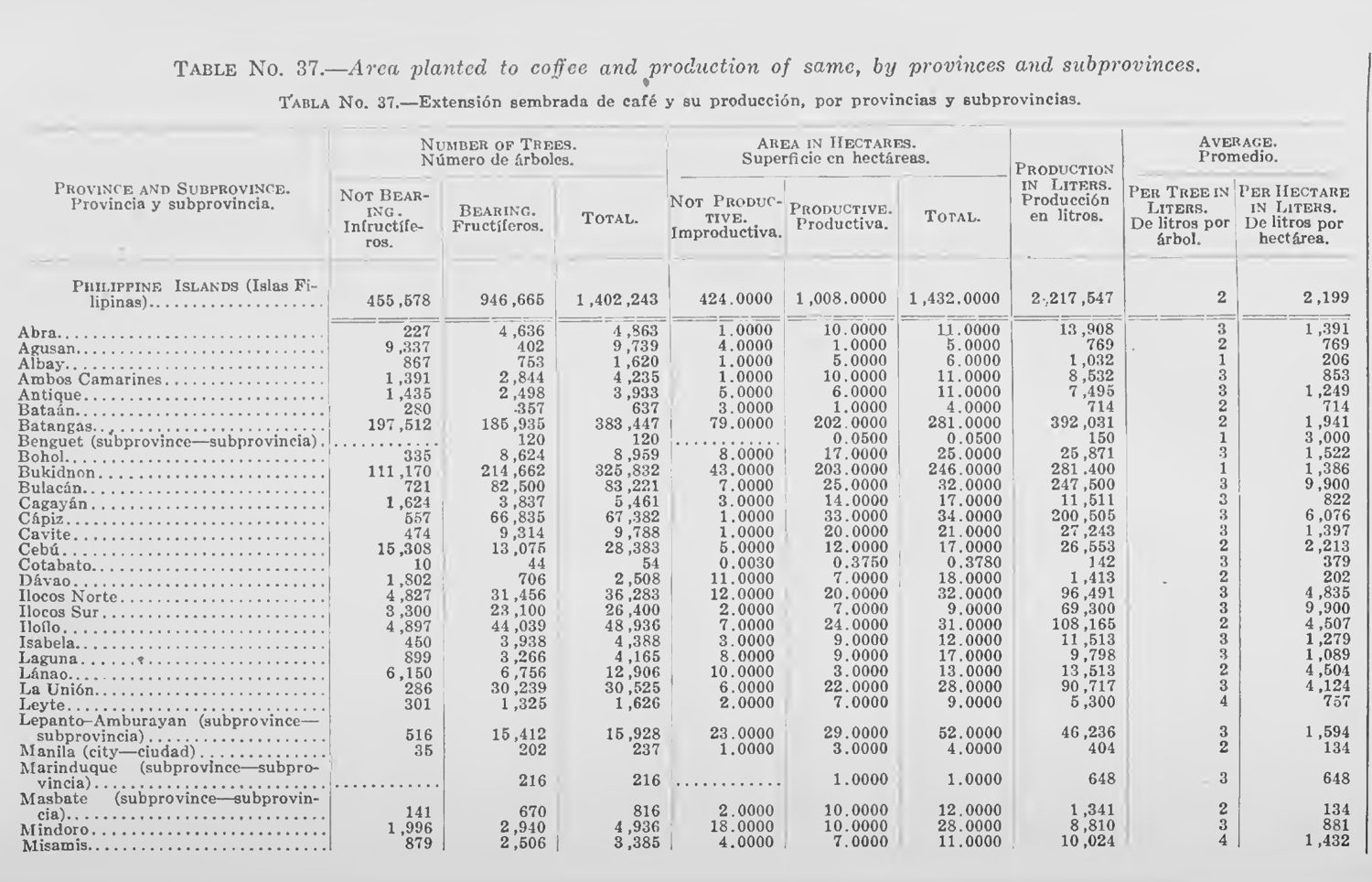
The census of 1918 counted what was left. The whole country had 1,432 hectares of coffee and 946,665 bearing trees. Batangas, once the centre of the trade, had 185,935 of them. The province with the most was Bukidnon, on the Mindanao tableland Wester had pointed to, with 214,662 bearing trees, nearly a quarter of the national count.11
Instant coffee
After the Second World War, coffee in the Philippines became a factory product. In the early 1950s government import controls choked the trade in imported consumer goods, and Nestlé's Philippine company, which had been importing NESCAFÉ, could not get enough to sell. In 1960 Nestlé and San Miguel Corporation formed Nutritional Products, Inc., and in 1962 its first factory opened in Alabang, Muntinlupa, to make NESCAFÉ in the country.12 The production series that begins the year before shows what followed.
Philippine coffee production, 1961 to 2024
Tonnes of green coffee per year, as reported to the UN Food and Agriculture Organization.
Source: FAOSTAT, Crops and livestock products, item "Coffee, green", Philippines (FAO, downloaded October 2026). FAO figures run well above the Philippine Statistics Authority's for recent years: for 2024 FAO estimates 64,000 tonnes, while the PSA reports 31,979 tonnes of green coffee. The long-run trend is the same in both.
Show the table
The FAO series begins at 32,300 tonnes in 1961, multiplies more than fivefold to a peak of 171,400 tonnes in 1982, and then falls for four decades, to about 60,000 tonnes a year in the 2020s.5 The government's own count is about half that: the Philippine Statistics Authority puts green coffee at 30,000 to 36,000 tonnes a year since 2015, 35,646 tonnes in 2025.22 The end of the International Coffee Agreement's export quotas in 1989 and the world price crisis of 2000 to 2001 hit smallholders hard, and farms were turned over to other crops.6 Meanwhile Filipinos drank more coffee than ever, most of it instant: by the 2010s Nestlé Philippines, in Cagayan de Oro, was the largest local maker of soluble coffee, with about 80 per cent of the instant market, and the country had become a net importer of coffee.7
Four species today
The Philippines grows all four commercial coffees. The Philippine Statistics Authority's figures for 2015, used in the Department of Agriculture's coffee roadmap, give their shares of the national green-bean harvest of 36,171 tonnes:7
Robusta
24,924 t. Lowland, mostly Mindanao, mostly for instant coffee.
Arabica
8,717 t. Grown above about 1,000 m, in the Cordillera and the Mindanao highlands.
Excelsa
2,273 t. Tart and fruity; long grown alongside Liberica.
Liberica
257 t. Kapeng barako, the giant bean of Batangas and Cavite.
Most of it comes from about 276,000 small farms with a median size of one to two hectares, often intercropped with coconut and fruit trees. Average yields were about 0.3 tonnes per hectare, a fraction of what well-kept farms achieve.7 That gap is the opening for today's specialty growers, roasters and cafés, who sell Philippine coffee by origin, variety and farm instead of as anonymous instant.
Mindoro and Bukidnon
Bukidnon
Mindanao has been in this story from the start. The 1903 census names Misamis, the old province that then included most of today's Bukidnon, among the main coffee areas of the Spanish era, alongside Cotabato.2 Bukidnon became a subprovince in 1907, and the next year the Bureau of Agriculture's journal described its coffee country. Coffee and cacao were "the principal crops on the slope of Quitanlad", today's Mount Kitanglad, and Sumilao was "the principal coffee-producing section in the market sphere of Cagayan", the port on the coast below.13 In 1910 an extension agent inspected the coffee in Tankulan, Maluko, Impasug-ong, Malaybalay and Sumilao and found the trees planted two metres apart; he told the farmers to space them at four.14 By the 1918 census Bukidnon had more bearing coffee trees than any other province, and in 1920 Wester published a photograph of "Arabian coffee in the third year" at Sumilao, which he put at 730 metres.1115 In the 2015 count Northern Mindanao, the region that includes Bukidnon, had 5.9 million bearing coffee trees.7 Bukidnon was known as a coffee province by the early 1980s; when prices fell, many farmers cut their trees for corn, and the provincial trade office has worked since 2010 to bring coffee back.8 Today's best-known Bukidnon Arabica grows on the foothills of the Kitanglad range, a protected area under Republic Act 8978 of 2000, at 1,000 metres and above. The Kalatungan range rises just to the south-west, across the Lantapan plateau.8
Mindoro
Mindoro is a smaller coffee island, which is part of its interest. The 1918 census found 4,936 coffee trees there, 2,940 of them bearing, on 28 hectares.11 In the 2015 count the MIMAROPA region, which includes Mindoro, had about 270,000 bearing coffee trees, a fraction of Mindanao's.7 Four species, one island: Mindoro's growers raise Robusta, Arabica, Excelsa and Liberica, and in October 2026 farmers from STACO, a people's organisation in San Mariano, Roxas, travelled to Valencia, Bukidnon, to train on the machines at BUKAPEX, a working processing facility.9